

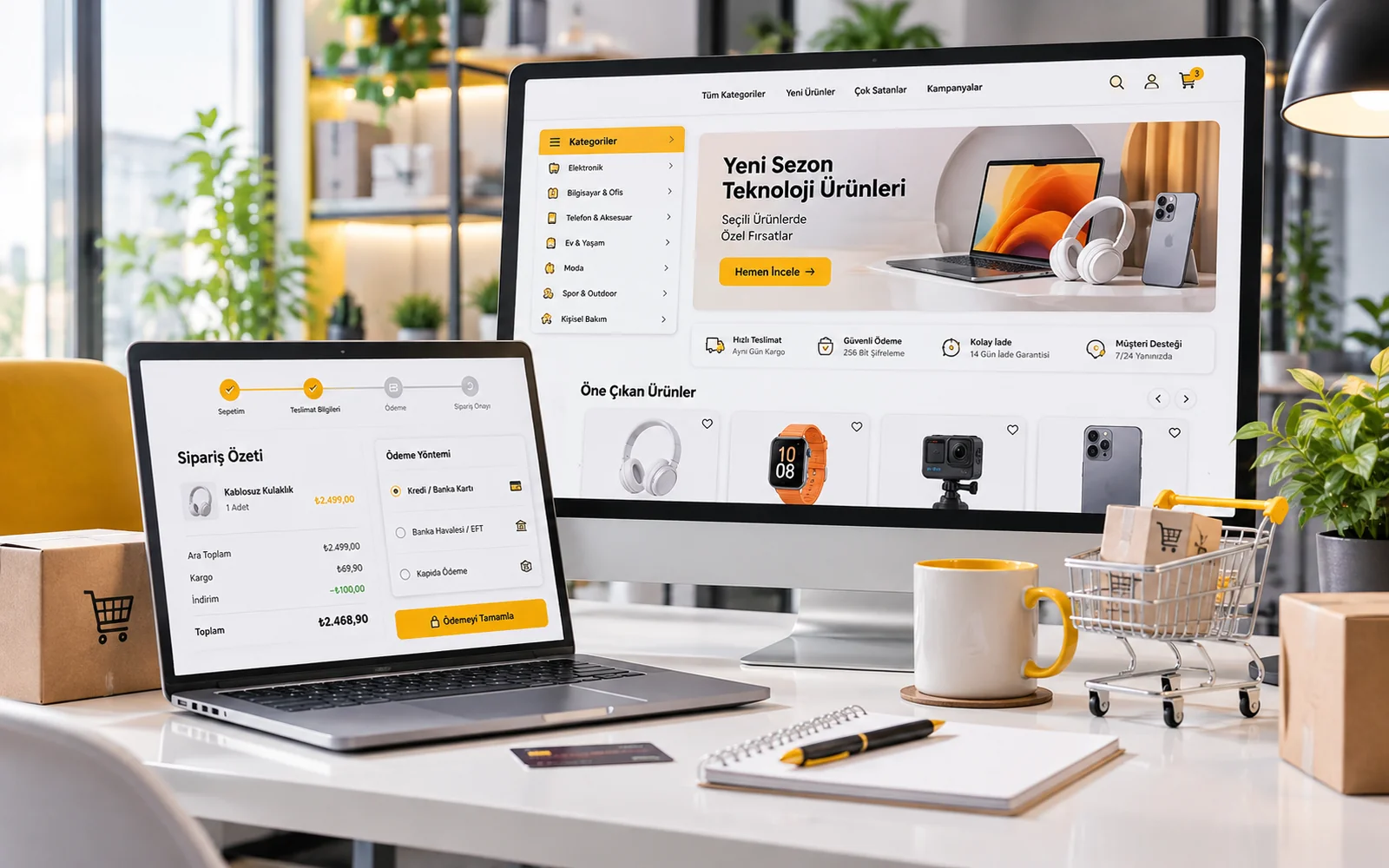
Representative image — screens, charts and figures are illustrative, not real client results.
What the ecommerce website service covers
An online shop is judged less by how it shows products and more by how smoothly it completes an order. A customer finds the product, picks a size or colour, reads shipping and return terms, pays on a phone and receives an order e-mail. If any link in that chain breaks, so does the sale. Lunor Medya plans ecommerce projects to cover the whole chain.
The scope includes the storefront, category and product structure, variant and stock logic, cart and checkout, shipping rules, campaigns and coupons, order notifications, placement of legal pages, tracking tags and admin training. Integrations such as marketplaces, ERP or accounting software are assessed separately during discovery.
Who it is for
- Manufacturers and brands opening their own store for the first time
- Businesses that sell only on marketplaces and want to reduce commission dependency
- Sellers whose current store is slow or loses many carts on mobile
- Companies that show different prices to dealers or run wholesale and retail together
- Retailers who want to manage shop-floor stock alongside online sales
If you do not need a cart or online payment, and product presentation with a quote form is enough, a corporate website is a leaner and more economical choice.
Our recommended approach
The platform is chosen based on catalogue size, operational complexity and your team's habits. If the catalogue is simple, the content team already knows WordPress and orders follow a standard flow, WooCommerce is a solid base. If you need dealer pricing, custom quotes, multi-warehouse stock or real-time data exchange with another system, a custom Laravel store and admin panel gives you more control.
The Ecommerce Website package starts from 30,000 TL (VAT included). The final price is set by quote, depending on the number of products and variants, payment and shipping integrations, languages and custom modules.
Technical and operational features
Catalogue and product management
- Category tree and filters built around how people search
- Separate stock and price tracking for variants such as colour, size or dimensions
- Bulk product upload and updates via Excel/CSV
- Delivery time, return terms and stock status clearly visible on product pages
Cart, checkout and shipping
- Virtual POS or payment provider integration (the agreement is made in your business name)
- Short checkout steps on mobile, with guest checkout where it makes sense
- Shipping fee rules by region, basket value or weight
- Coupons, basket discounts and campaign settings
Orders and customers
- Order statuses with automatic e-mail updates to the customer
- Distance sales agreement, pre-information form and privacy texts built into checkout
- Customer account, order history and return request screen
- Tracking tags for add-to-cart and purchase events
How we work
- Operations meeting: We look at how orders flow today, where stock is kept, and how shipping and returns work.
- Platform decision: WooCommerce or custom software, with the reasoning written down.
- Catalogue plan: Category tree, variant structure and filters are defined.
- Design: Drafts for the home, category, product and cart pages.
- Development and integration: Payment, shipping and any external system connections are set up.
- Product upload: The first product set is entered together and a bulk upload template is prepared.
- End-to-end test: A real order is run through payment, notifications, stock deduction and returns.
- Launch and training: The store opens and your team is shown how to manage orders and products.
What we need from you
- Product list: names, descriptions, prices, variants and stock levels
- Product photos you hold the rights to
- An application to a payment provider or a bank's virtual POS
- A shipping carrier agreement and dispatch rules
- Return, exchange and delivery policy texts
- Company, tax and legal details
Payment and shipping agreements are made in your business name, so starting those applications early protects the launch date.
Delivery and service model
The project timeline is given in writing after discovery, based on catalogue size and the number of integrations. The launch criterion is not finished design but a test order that passes every step without errors.
At handover you receive admin access, the product upload template and a short user guide. Server needs can change as traffic grows, so the hosting and infrastructure plan is discussed at the start. If you are considering stock and marketplace connections, our article on ecommerce stock and marketplace integration is worth reading before you decide.
Benefits
- Built around operations: the store reflects how orders are actually prepared.
- Tested flow: payment, notifications and stock deduction are tried with a real scenario before launch.
- Your own channel: customer data and campaign decisions are not bound by marketplace rules.
- Extendable: new payment methods, languages or integrations can be added later.
Related services
Once the store is open, ecommerce SEO work can help category and product pages get found in search. Product photography, Google Ads and Meta advertising can be handled by the same team.
What we deliver
- Catalogue and variants built around operations
- Virtual POS and payment provider integration
- Shipping fee rules
- Short mobile checkout
- Coupons and campaigns
- Order notifications and customer accounts
- Tracking tags
- End-to-end test order and admin training
Frequently asked about this service
The Ecommerce Website package starts from 30,000 TL (VAT included). Product and variant counts, integrations, languages and custom modules set the final price, which is given by quote after discovery.
For a simple catalogue and standard order flow, WooCommerce is usually enough. If you have dealer pricing, multi-warehouse stock, approval steps or real-time data exchange with another system, a custom Laravel build gives more control. The decision is made, with reasons, in the operations meeting.
A standard payment provider and shipping setup is considered part of the package. Extras such as several payment methods, multiple carriers or a custom carrier API are listed separately in the quote. Agreements are made in your business name.
Yes. You can add and update products one by one in the admin panel or in bulk with an Excel/CSV template. The first product set is entered together during handover and the panel is demonstrated.
As long as the data can be exported, products, categories and images can be migrated. Moving customer and order data is assessed separately under data protection rules. A redirect plan is prepared for changed URLs.
Marketplace and stock synchronisation is handled as a separate scope. The marketplaces involved, product matching method and stock update frequency are defined during discovery and reflected in the quote.
No. Sales depend on product, price, traffic and advertising. We deliver a store where payment and order flows work and tracking is in place; SEO and advertising for traffic are planned separately.